

 When I reviewed Automatic Data Processing (ADP) in this October 30, 2025 post, it had just released Q1 2026 results and a very moderate revision to its FY2026 outlook. In that post I disclose the purchase of 200 shares @ $269.78 in a ‘Core’ account in the FFJ Portfolio on October 29. I also state my intent to acquire additional shares if ADP’s valuation remains attractive.
I commence that post stating:
I have been an ADP shareholder for decades. The majority of my exposure is through a tax efficient Registered Retirement Savings Plan (RRSP) account for which I do not disclose details. I have made no additional RRSP contributions following my retirement in May 2016. Through the accumulation of cash from the portion of dividend income received from the various holdings in my RRSP that was not automatically reinvested, however, I have increased my exposure in July 2020 (see post), January 2023 (see post), and July 2023. I also acquired 100 shares @ ~$197.74 in a taxable ‘Side’ account in the FFJ Portfolio (see post) on January 26, 2022.
I need to increase my ADP exposure in taxable accounts to offset the shares held in RRSPs that I will eventually need to sell as part of my RRSP meltdown strategy.
As luck would have it, ADP’s share price has fallen from the ~$330 level in the first week of June 2025. Following the release of Q1 2026 results and FY2026 outlook on October 29, ADP’s share price closed at $261.22.
ADP’s share price weakened subsequent to that purchase and in my November 3 post, I disclose the purchase of another 100 shares @ $256.035 in the same ‘Core’ account.
With the release of Q2 and YTD2026 results and revisions to the FY2026 outlook on January 28 and a $250.69 closing share price, it is an opportune time to revisit ADP.
Business Overview
Please review the company’s website and read Part 1 Items 1 (Business) and 1A (Risk Factors) in the FY2025 Form 10-K that is accessible through the SEC Filings section of the company’s website if you are unfamiliar with ADP.
Financials
Q2 and YTD2026 Results
The material released on January 28, 2026 is accessible here.
NOTE: ADP’s fiscal year end is the end of June.
Conventional And Modified Free Cash Flow (FCF) Calculations (FY2017 – FY2025 and YTD2026)
In several posts I express my thoughts about the way many companies calculate Free Cash Flow (FCF). Since FCF is a non-GAAP metric, there is no standardization in its calculation.
In most cases, companies merely deduct net CAPEX from net cash flows from operating activities. ADP, however, calculates FCF by subtracting CAPEX and Additions to Intangibles from Net Cash Flows provided by operating activities. I am more conservative and also deduct share based compensation (SBC) to arrive at ADP’s modified FCF.
In my recent RTX Corporation’s Current Valuation Makes It An Imprudent Investment I touch upon why I deduct SBC to determine a company’s FCF.

Clients Funds Investment Strategy
Note 5 in ADP’s FY2025 Form 10-K starting on page 63 of 97 provides a comprehensive overview of ADP’s Clients Funds Investment Strategy.
The purpose of this Investment Strategy is to generate income from significant client fund balances. When deemed prudent, ADP will further enhance its investment returns by investing long and borrowing short to take advantage of the yield spread.
This strategy allows ADP to average its way through an interest rate cycle by laddering the maturities of investments out to 5 years (in the case of the extended portfolio) and out to 10 years (in the case of the long portfolio). ADP’s short-term financing arrangements necessary to satisfy short-term funding requirements relating to client funds obligations supports this investment strategy.
Management provided the following commentary on its Q1 2026 earnings call:
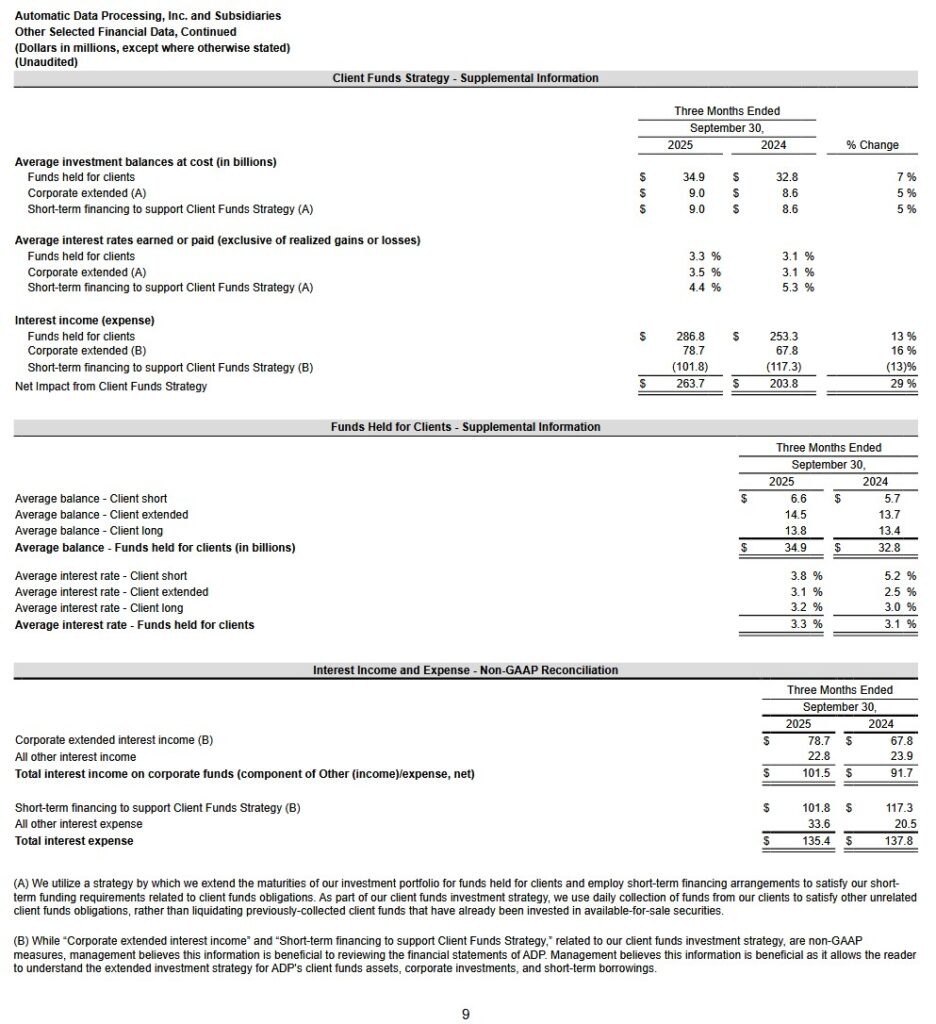
Client funds interest revenue increased more than we anticipated in Q1, helped by stronger average client funds balance growth, while the yield curve has declined marginally since our last update. This impact is more than offset by our stronger client funds balance growth. We are now forecasting average client funds balances to grow 3% – 4% in FY2026, and we are continuing to expect an average yield of ~3.4%. Accordingly, we are increasing our full year forecast for client funds interest revenue by $10 million to a range of $1.30B – $1.32B. We are also increasing our expected net impact from our extended investment strategy by $10 million to a range of $1.26B -$1.28B.
On the Q2 2026 earnings call, management states:
As we highlighted on our Q1 conference call, we do expect positive contribution to overall ADP margins this year from our other segment as a result of our client funds extended investment strategy. This margin contribution is being driven by growth in our corporate extended interest income, while at the same time, our short-term financing costs are decreasing. We saw this in the second quarter, and we expect this dynamic to continue across the balance of the fiscal year.
The following reflects the results of ADP’s client funds investment strategy in FY2025 and YTD2026.

Q2 FY2026 and Q2 FY2025 Results of ADP’s Client Funds Investment Strategy

Q1 FY2026 and Q1 FY2025 Results of ADP’s Client Funds Investment Strategy
FY2026 Outlook
ADP’s FY2025 results and current and prior FY2026 outlook is found below.

Return On Invested Capital (ROIC)
ROIC provides an indication of a company’s efficiency. In essence, how much profit is generated for every dollar invested in the company – is a company actually creating value or ‘burning’ cash for the sake of growth?
A company with a higher ROIC is mathematically worth more because it requires less reinvestment to achieve that growth.
A good indication of how well a company is performing is to compare the Weighted Average Cost of Capital (WACC) versus the ROIC.
The generally accepted high-level formula used by Wall Street is:
ROIC = NOPAT/Average Invested Capital
with the Net Operating Profit After Tax (NOPAT) formula being Operating Income (EBIT) x (1-tax rate)
This shows how much profit the core business makes while ignoring how much debt the company has.
The Average Invested Capital is the total money tied up in the business.
- The Operating Approach formula is
- The Financing Approach is
ROIC, however, has some shortcomings which I touch upon in recent prior posts. One shortcoming is that it is a non-GAAP metric meaning the input data plugged into the ROIC formula is inconsistent.
Various sources reflect ADP’s ROIC in FY2019 – FY2025 as being the ~30% – ~54% range. There is no consistency with annual ROIC results varying slightly during this time frame. Even if we take the lowest annual ROIC results and apply a ~5% margin of error, however, the annual ROIC should still exceed ADP’s WACC.
In FY2019 – FY2021, ADP’s WACC was ~7.2%, ~6.8%, and ~7.5% because of the low interest rate environment.
The WACC rose to ~8.1%, ~8.9%, ~8.3%, and ~7.6% in FY2022 – FY2025 because of a rising interest rate environment, greater market volatility, and an increase in ADP’s long-term debt from ~$2B at FYE2019 to ~$3.976B at the end of Q2 2026. Despite the higher WACC and higher long-term debt level ADP’s capital allocation benefits shareholders. Its annual dividend distribution rose from ~$1.3B to ~$2.5B and the diluted weighted average shares outstanding dropped from ~437.6 million in FY2019 to ~404.7 million in Q2 2026.
Risk Assessment
Every investment comes with potential reward and risk. Regrettably, some investors never assess an investment’s potential risks OR they overestimate their risk tolerance.
My investor profile is such that I invest in high quality companies with a promising future. I am, therefore, prepared to forego ‘potential reward’ if the risk is likely to lead to a ‘loss of sleep’.
While the credit rating agencies are not infallible, I take into consideration their take on a company’s risk. The following are ADP’s senior domestic unsecured long-term debt ratings:
- Moody’s: Aa3 with a stable outlook – affirmed on October 15, 2024
- S&P Global: AA- with a stable outlook – affirmed on March 17, 2025
- Fitch: AA- with a stable outlook – affirmed on October 17, 2025
All 3 ratings are the lowest tier of the high grade investment grade category. These ratings define ADP as having a very strong capacity to meet its financial commitments. These ratings differ from the highest-rated obligors only to a small degree.
NOTE: Equity investors have greater risk exposure than senior domestic unsecured long-term debt holders. Investing in a company whose credit ratings are the lowest investment grade levels, therefore, means an equity investor assumes non-investment grade risk.
I also look at the details of a company’s Operating Leases, Short-Term Financing, and Long-Term Debt.
As I compose this post, ADP’s Q2 2026 Form 10-Q is unavailable. ADP’s long-term debt at the end of Q2 2026 is ~$3.976B which is virtually the same as in Q1 2026 and FYE2025. I, therefore, reference Notes 7, 9, and 10 in its FY2025 Form 10-K which detail the company’s financing arrangements.

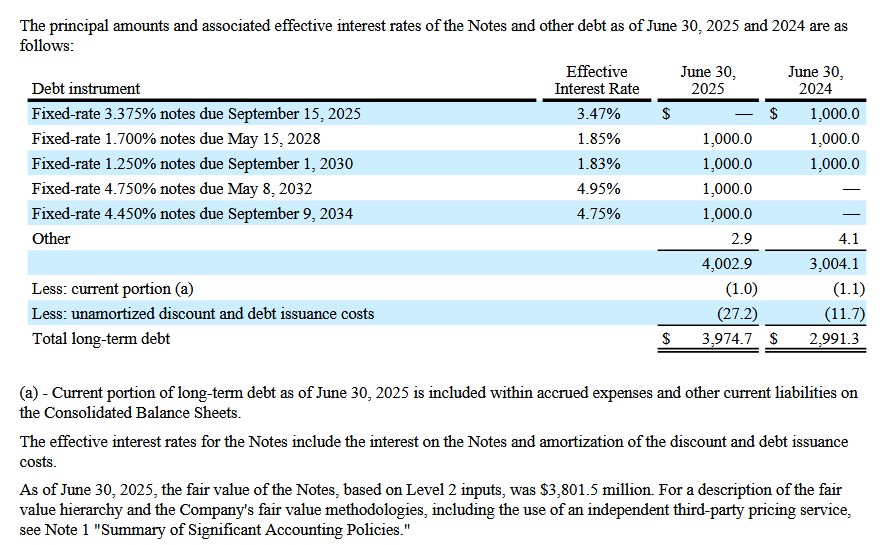
ADP has no long-term debt maturing until May 15, 2028. This leaves it just over 2 years to accumulate ~$1B in order to retire the debt due on May 15, 2028. This should be easily attainable thus leaving ADP with considerable flexibility from a capital allocation perspective.
Dividends and Share Repurchases
Dividend and Dividend Yield
ADP has increased its dividend for 50 consecutive years in November 2024 (see dividend history).
In my prior post I state:
I anticipate ADP will announce in early November at least a 10% increase to the current $1.54 quarterly dividend.
The quarterly dividend was increased to $1.70 – a ~10.4% increase.
Relying on dividend metrics to make investment decisions, however, is a fundamentally flawed method by which to invest. Investors would be wise to look at the TOTAL potential return.
Share Repurchases
Management has done a commendable job of reducing the issued and outstanding shares. In the FY2017, there were 450.3 million outstanding shares. In Q2 2026, the weighted average outstanding shares was 404.7 million.
ADP repurchased 4.4 million shares in FY2025 versus 5.1 million shares repurchased in FY2024. It considers several factors in determining when to execute share repurchases, including, among other things, actual and potential acquisition activity, cash balances and cash flows, issuances due to employee benefit plan activity, and market conditions.
YTD2026, ADP has repurchased ~$0.882B of its shares.
On January 14, 2026, ADP’s Board authorized the purchase of $6B of common stock, which replaced, in its entirety, the 2022 $5B authorization.
Valuation
Management’s FY2026 revised adjusted diluted EPS outlook is 9% – 10% growth from $10.01 in FY2025 or ~$10.91 – ~$11. ADP’s share price as I compose this post on January 28 is $250.69 giving us a forward adjusted diluted PE of ~22.8 – ~23.
ADP’s forward adjusted diluted PE levels using the current brokers’ adjusted diluted earnings estimates are:
- FY2026: 17 brokers – current mean $10.95 and $10.89/$11.03 low/high range; ~23 using the mean.
- FY2027: 17 brokers – current mean $11.95 and $11.41/$12.33 low/high range; ~21 using the mean.
- FY2028: 9 brokers – current mean $12.97 and $12.32/$13.27 low/high range; ~19.3 using the mean.
The FCF/Net EPS ratio is likely to improve as the year progresses. On a modified basis, I continue to envision the ratio will likely be ~90% – ~95%. If my estimate is correct, ADP’s P/FCF valuation will be slightly worse than on an adjusted PE basis. Nevertheless, my valuation estimates using adjusted earnings and FCF continue to be superior to ADP’s valuation at just about every point in the last few years.
In my November 3, 2025 post I reflect the following:
ADP’s closing share price on November 3, 2025 is $257.17 but I acquired shares at $256.035.
The forward adjusted diluted PE levels using the current brokers’ adjusted diluted earnings estimates and my purchase price are:
- FY2026: 16 brokers – current mean $10.91 and $10.67/$11.00 low/high range; ~23.5 using the mean.
- FY2027: 16 brokers – current mean $11.94 and $11.39/$12.40 low/high range; ~21.4 using the mean.
- FY2028: 9 brokers – current mean $13.02 and $12.49/$13.60 low/high range; ~19.7 using the mean.
ADP’s valuation was extremely high in early June 2025 (52 week high share price of ~$330) considering ~$280 is what I consider to be fair.
The following reflects my valuation estimate at the time of my October 30, 2025 post.
In FY2025, ADP generated $9.98 and $10.01 of diluted EPS and adjusted diluted EPS. Current FY2026 guidance calls for a 8% – 10% increase from FY2025’s adjusted diluted EPS (~$10.81 – ~$11.01).
ADP’s closing share price on October 29, 2025 is $261.22 giving us a forward adjusted diluted PE of ~23.7 – ~24.2.
ADP’s forward adjusted diluted PE levels using the current brokers’ adjusted diluted earnings estimates are:
- FY2026: 16 brokers – current mean $10.93 and $10.85/$11.00 low/high range; ~24 using the mean.
- FY2027: 16 brokers – current mean $11.96 and $11.39/$12.40 low/high range; ~21.8 using the mean.
- FY2028: 9 brokers – current mean $13.02 and $12.49/$13.35 low/high range; ~20 using the mean.
The FCF/Net Earnings Ratio in Q1 2026 is likely to improve as the year progresses. On a modified basis, I envision the ratio will likely be ~90% – ~95%. If my estimate is correct, ADP’s P/FCF valuation will be slightly worse than on an adjusted PE basis. Nevertheless, my valuation estimates using adjusted earnings and FCF are superior to ADP’s valuation at just about every point in the last few years.
Final Thoughts
ADP was my 10th largest holding when I completed my 2025 Year-End Investment Holdings Review. The share price at the time was ~$257.23.
My Final Thoughts are unchanged from those reflected in my October 30, 2025 post. The exception is that I consider ADP to currently be slightly more attractively valued than at the time of my last two purchases.
I view a fair value as being in the ~$290 – ~$295 range. Using the ~$10.96 mid-point of management’s FY2026 forward adjusted diluted EPS guidance of ~$10.91 – ~$11, this fair value range gives us a forward adjusted diluted PE range of ~26.5 – ~27. Given my opinion about ADP’s long-term outlook, the current valuation appears to be very attractive. With its new $6B share repurchase Board approval in place, I hope the company takes advantage of this current valuation and repurchases a considerable number of shares.
I wish you much success on your journey to financial freedom!
Note: Thanks for reading this article. Please send any feedback, corrections, or questions to finfreejourney@gmail.com.
Disclosure: I am long ADP.
Disclaimer: I do not know your circumstances and am not providing individualized advice or recommendations. I encourage you not to make any investment decisions without conducting your research and due diligence. You should also consult your financial advisor about your specific situation.
I wrote this article myself and it expresses my own opinions. I am not receiving compensation for it and have no business relationship with any company whose stock is mentioned in this article.
